
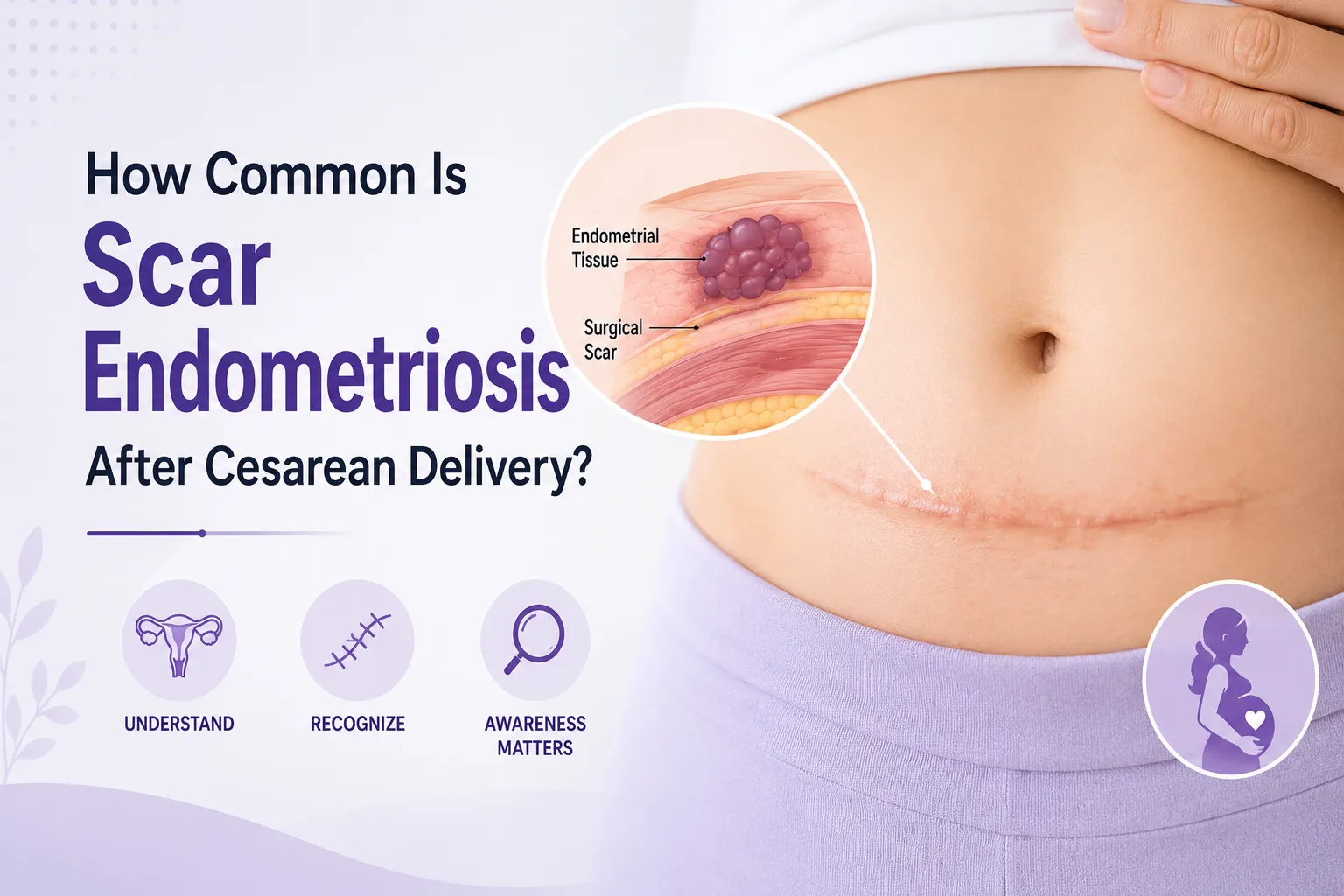
A cesarean delivery is one of the most commonly performed surgical procedures worldwide. While most women recover without complications, some experience persistent pain or develop a lump near their C-section scar months or even years after childbirth.
Many women initially assume that this discomfort is a normal part of postoperative healing. However, in some cases, these symptoms may indicate a rare condition known as scar endometriosis.
Although scar endometriosis is uncommon, delayed diagnosis is extremely common because its symptoms often resemble those of hernias, infections, lipomas, or scar tissue.
Understanding the warning signs can help women seek timely treatment and avoid years of unnecessary discomfort.
What Is Scar Endometriosis?
Scar endometriosis occurs when endometrial tissue, which normally lines the inside of the uterus, grows within or around a surgical scar.
During a cesarean section, small amounts of endometrial tissue may accidentally become implanted into the abdominal wall. Over time, these cells continue responding to hormonal changes during the menstrual cycle.
As the tissue grows, it can cause pain, swelling, inflammation, and the formation of a mass near the scar.
Unlike pelvic endometriosis, which develops inside the pelvis, scar endometriosis develops within the surgical incision.
How Common Is Scar Endometriosis After a Cesarean Delivery?
Scar endometriosis is considered a rare complication after a C-section.
Studies suggest that the condition affects a small percentage of women who undergo cesarean delivery. However, specialists believe that many cases remain undiagnosed because the symptoms are frequently mistaken for other surgical complications.
The risk increases in women who have undergone:
- One or more cesarean deliveries
- Gynecological surgery
- Hysterectomy
- Laparoscopic procedures
- Abdominal surgery involving the uterus
Although the condition is uncommon, awareness is increasing because cesarean delivery rates continue to rise.
What Causes Scar Endometriosis?
The most widely accepted theory is the direct implantation of endometrial cells during surgery.
During a cesarean delivery, cells from the uterine lining may become trapped within the abdominal incision. These cells remain active and continue responding to monthly hormonal changes.
Several factors may contribute to the development of scar endometriosis, including:
- Cesarean delivery
- Repeated uterine surgeries
- Surgical manipulation of uterine tissue
- Hormonal stimulation
- Previous gynecological procedures
The condition may develop months or even several years after surgery.
Symptoms of Scar Endometriosis
The symptoms can vary from one woman to another, but certain signs are highly characteristic.
Common symptoms include:
- Pain around the cesarean scar
- A painful lump near the incision
- Swelling around the scar
- Tenderness during menstruation
- Cyclical pain that worsens during periods
- A firm abdominal mass
- Skin discoloration around the scar
The most important warning sign is pain that becomes more severe during the menstrual cycle.
Many women describe the pain as sharp, burning, or pulling.
How Can You Tell the Difference Between Normal Scar Pain and Scar Endometriosis?
Some discomfort after a cesarean delivery is completely normal. However, normal postoperative pain usually improves within weeks.
You should seek medical attention if you notice:
| Normal Healing | Possible Scar Endometriosis |
| Improves gradually | Becomes worse over time |
| Disappears within weeks | Persists for months or years |
| No cyclical pattern | Worsens during menstruation |
| No lump | A noticeable mass develops |
Any scar-related pain that follows a menstrual pattern should never be ignored.
How Is Scar Endometriosis Diagnosed?
Diagnosis begins with a detailed medical history and physical examination.
Your gynecologist may ask questions such as:
- When did the pain begin?
- Does the pain become worse during periods?
- Have you noticed a lump?
- Have you undergone a cesarean delivery or other gynecological surgeries?
Additional investigations may include:
Ultrasound
An ultrasound can help identify masses within the abdominal wall.
MRI Scan
An MRI provides a more detailed evaluation and helps determine the size and extent of the lesion.
Physical Examination
An experienced gynecologist can often identify scar endometriosis based on the characteristic symptoms and examination findings.
What Is the Best Treatment for Scar Endometriosis?
Surgical removal is considered the most effective treatment.
Pain medications and hormonal therapies may provide temporary symptom relief, but they usually do not eliminate the abnormal tissue.
Surgical Excision
During surgery, the affected tissue is completely removed.
The goal is to:
- Remove all endometriotic tissue
- Relieve pain
- Prevent recurrence
- Restore normal abdominal wall function
Complete surgical excision significantly reduces the likelihood of the condition returning.
Can Scar Endometriosis Affect Fertility?
Scar endometriosis itself does not always affect fertility.
However, some women with scar endometriosis may also have pelvic endometriosis.
Pelvic endometriosis can affect:
- Ovarian function
- Fallopian tubes
- Egg quality
- Implantation
A comprehensive gynecological evaluation can help determine whether additional endometriotic lesions are present.
When Should You See a Gynecologist?
Schedule an appointment if you experience:
- Persistent pain after a cesarean delivery
- A painful lump near your scar
- Cyclical abdominal pain
- Unexplained swelling around the incision
- Pain that worsens during menstruation
Early diagnosis can prevent unnecessary suffering and reduce the risk of complications.
Why Choose Dr. Balaji Nalwad Reddy for Scar Endometriosis Treatment in Pune?
Dr. Balaji Nalwad Reddy is a consultant gynecologist, laparoscopic surgeon, hysteroscopic surgeon, and robotic surgeon with more than 23 years of clinical experience.
He has successfully performed more than 20,000 gynecological procedures across India and Africa.
His areas of expertise include:
- Advanced endometriosis management
- Complex laparoscopic surgery
- Fertility-enhancing procedures
- Minimally invasive gynecological surgery
- Robotic gynecological surgery
His advanced international training in Spain and the United States, combined with extensive experience in minimally invasive procedures, enables him to manage complex endometriosis cases with precision.
If you are searching for a Scar Endometriosis Specialist in Pune, early consultation can help identify the cause of your symptoms and ensure appropriate treatment.
Frequently Asked Questions
Can scar endometriosis appear years after a C-section?
Yes. Symptoms may develop several months or even several years after cesarean delivery.
Is scar endometriosis cancerous?
No. Scar endometriosis is a benign condition. However, it should still be evaluated and treated by a specialist.
Can medication cure scar endometriosis?
Medication may reduce symptoms temporarily, but complete surgical removal remains the most effective treatment.
Does every painful C-section scar indicate endometriosis?
No. Pain may result from infection, scar tissue, or other conditions. A proper diagnosis is necessary.
Is scar endometriosis preventable?
There is no guaranteed prevention method. However, careful surgical techniques may reduce the risk.
