
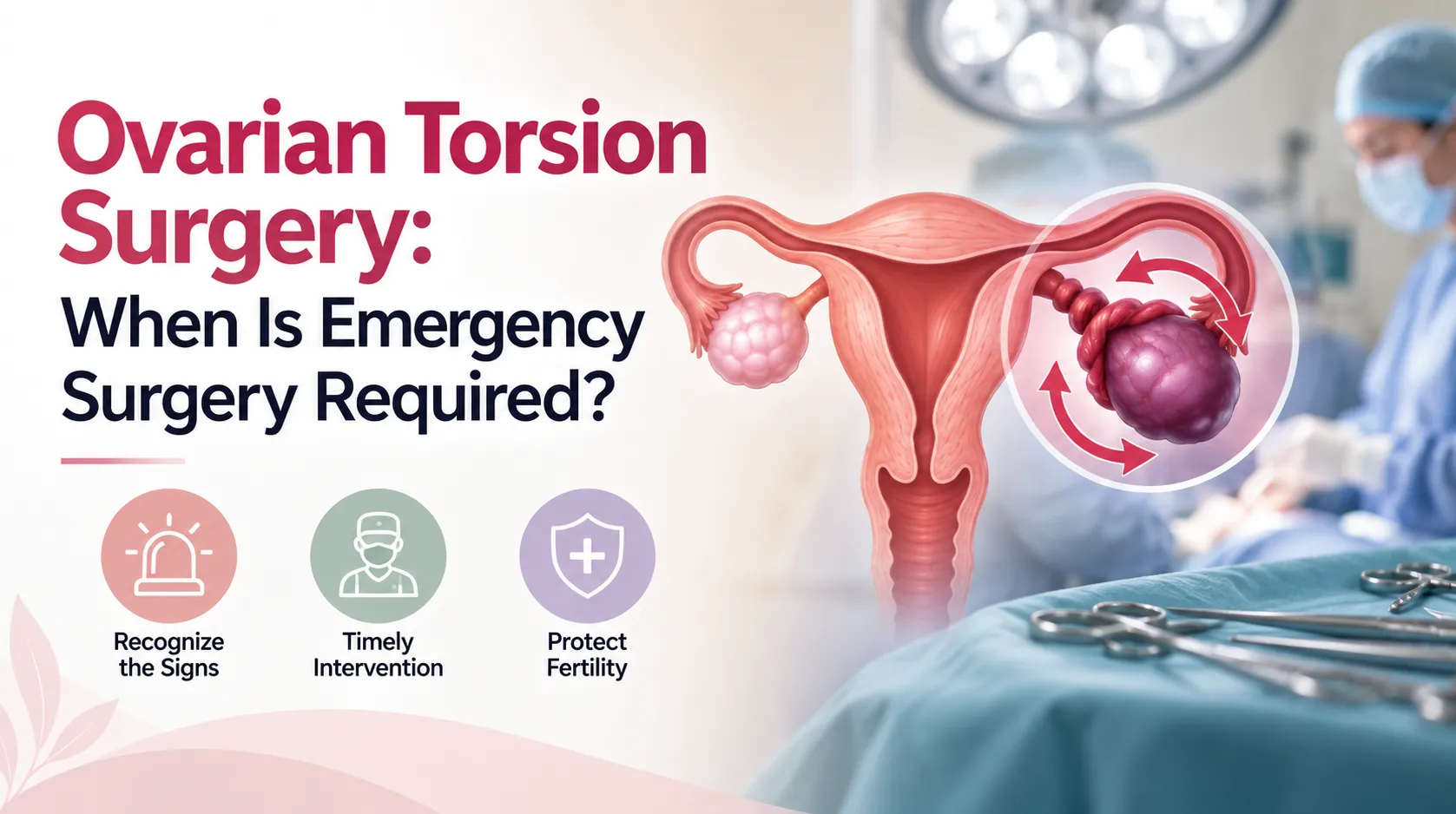
Sudden, severe pelvic pain can be frightening, especially when it comes without warning. While there are many possible causes of pelvic pain, one condition that requires urgent medical attention is ovarian torsion.
Ovarian torsion occurs when an ovary twists around the tissues that support it, potentially reducing or completely cutting off its blood supply. If the blood supply remains blocked, the ovarian tissue can become damaged.
This is why ovarian torsion is considered a gynecological emergency. Prompt evaluation and, when necessary, emergency surgery can help protect the ovary and prevent serious complications.
What Is Ovarian Torsion?
Ovarian torsion, also called adnexal torsion, happens when an ovary twists around its supporting ligaments. The fallopian tube may twist along with the ovary.
The twisting can restrict:
- Blood flow into the ovary
- Blood flow out of the ovary
- Normal ovarian function
Ovarian torsion can occur at any age, but it is more common in women who have an enlarged ovary or an ovarian cyst or mass.
The condition can develop suddenly and requires immediate medical assessment.
What Causes Ovarian Torsion?
Anything that increases the size or weight of an ovary can increase the risk of twisting.
Common causes and risk factors include:
- Ovarian cysts
- Benign ovarian tumors
- Enlarged ovaries
- Polycystic ovaries
- Fertility treatment
- Previous ovarian torsion
- Pregnancy
- Occasionally, torsion can occur without an obvious ovarian mass
An ovarian cyst is one of the most common factors associated with torsion because it can make the ovary heavier and more likely to rotate.
What Are the Symptoms of Ovarian Torsion?
The symptoms can appear suddenly and may become severe within a short period.
The most common symptoms include:
- Sudden, severe lower abdominal or pelvic pain
- Pain predominantly on one side
- Nausea
- Vomiting
- Abdominal tenderness
- Pelvic pressure
- Pain that comes and goes
- Fever in some cases
Some women experience intermittent pain because the ovary may twist and partially untwist.
This does not mean the condition is harmless. Repeated episodes still require urgent medical evaluation.
Is Ovarian Torsion an Emergency?
Yes. Suspected ovarian torsion requires urgent medical assessment.
When the ovary twists, its blood supply can become compromised. The longer the ovary remains without adequate blood flow, the greater the risk of permanent tissue damage.
If you suddenly develop severe one-sided pelvic or lower abdominal pain, particularly when accompanied by nausea or vomiting, do not wait for the symptoms to disappear on their own.
Seek emergency medical care immediately.
When Is Emergency Surgery Required?
Emergency surgery is generally considered when ovarian torsion is strongly suspected or confirmed and the ovary is at risk of losing its blood supply.
Surgery may be necessary when:
- Severe sudden pelvic pain suggests torsion
- Imaging indicates a twisted or enlarged ovary
- Blood flow to the ovary appears compromised
- Symptoms continue or worsen
- An ovarian cyst or mass is causing the ovary to twist
- There is concern about ovarian tissue damage
Because ovarian torsion can progress quickly, treatment decisions are based on the overall clinical picture rather than waiting for symptoms to resolve.
Can Ovarian Torsion Be Treated Without Surgery?
In most cases, surgery is the definitive treatment when torsion is suspected.
Pain medicines may temporarily reduce discomfort, but they do not untwist the ovary or restore blood flow.
The priority is to assess the ovary quickly and determine whether surgical intervention is required.
How Is Ovarian Torsion Diagnosed?
Diagnosing ovarian torsion can be challenging because its symptoms can resemble other conditions, including ovarian cyst rupture, appendicitis, kidney stones, or ectopic pregnancy.
A gynecologist may use:
Pelvic Examination
The doctor evaluates the location and severity of pain and checks for abdominal or pelvic tenderness.
Ultrasound
Pelvic ultrasound is commonly used to assess:
- Ovarian size
- Ovarian cysts or masses
- Ovarian structure
- Blood flow using Doppler imaging
However, normal blood flow on an ultrasound does not always completely rule out torsion.
Blood and Urine Tests
These may help identify infection, inflammation, pregnancy, or other possible causes of acute pelvic pain.
Diagnostic Laparoscopy
If ovarian torsion remains strongly suspected, minimally invasive surgery may be required both to confirm the diagnosis and treat the condition.
What Happens During Ovarian Torsion Surgery?
The surgical approach depends on the patient’s age, the condition of the ovary, the underlying cause, and whether the tissue remains viable.
Laparoscopic Detorsion
During laparoscopy, the surgeon makes small abdominal incisions and uses specialized instruments to locate and untwist the affected ovary.
The primary goal is to restore blood flow and preserve the ovary whenever safely possible.
Treatment of an Ovarian Cyst or Mass
If a cyst or benign mass caused the torsion, the surgeon may remove it while preserving as much healthy ovarian tissue as possible.
Removal of the Ovary
In some cases, the ovary may be severely damaged or non-viable and removal may be necessary. The decision depends on the condition of the tissue and the patient’s individual circumstances.
For women of reproductive age, preserving healthy ovarian tissue is an important consideration whenever medically appropriate.
Can the Ovary Be Saved After Torsion?
Often, yes particularly when treatment is provided promptly.
The appearance of an ovary during surgery does not always accurately predict whether it will recover after blood flow is restored. Therefore, surgeons may attempt to untwist and preserve the ovary when appropriate.
Early treatment is one of the most important factors in protecting ovarian function.
Can Ovarian Torsion Affect Fertility?
Ovarian torsion can potentially affect fertility if the ovary suffers significant damage or needs to be removed.
However, having one healthy ovary does not necessarily mean a woman cannot become pregnant. The impact on fertility depends on factors such as:
- Condition of the affected ovary
- Health of the other ovary
- Fallopian tube health
- Age
- Overall reproductive health
- Underlying cause of the torsion
This is another reason why prompt treatment is important, particularly for women who wish to preserve their fertility.
Ovarian Torsion During Pregnancy
Ovarian torsion can also occur during pregnancy, particularly when an ovary is enlarged or affected by a cyst.
Sudden abdominal or pelvic pain during pregnancy should never be self-diagnosed.
Pregnant women experiencing severe or unexplained abdominal pain should seek immediate medical attention so that urgent conditions, including ovarian torsion and ectopic pregnancy, can be evaluated.
Can Ovarian Torsion Happen Again?
Yes. There is a possibility of recurrence, particularly if an underlying ovarian cyst, mass, or anatomical risk factor remains.
Depending on the individual situation, a gynecologist may discuss treatment options designed to reduce the risk of another torsion episode.
When Should You Go to the Emergency Room?
Seek emergency medical care if you experience:
- Sudden severe pelvic pain
- Severe pain on one side of the lower abdomen
- Pelvic pain accompanied by vomiting
- Sudden pain with a known ovarian cyst
- Severe abdominal tenderness
- Sudden pelvic pain during pregnancy
Do not rely on home remedies or wait several days to see whether the pain improves.
Why Choose Dr. Balaji Nalwad Reddy for Advanced Gynecological Surgery?
Dr. Balaji Nalwad Reddy is a consultant gynecologist, laparoscopic surgeon, hysteroscopic surgeon, and robotic surgeon in Pune.
He has more than 23 years of clinical experience and has performed 20,000+ gynecological surgeries. His areas of expertise include advanced laparoscopic and robotic gynecological procedures, endometriosis management, ovarian surgery, fertility-enhancing procedures, and complex gynecological conditions.
His training includes advanced laparoscopic and endoscopic experience in Spain and a Fellowship in Minimal Access Surgery in the USA. He is also involved in medical education and training gynecologists in advanced laparoscopic and endoscopic techniques.
For conditions requiring urgent or minimally invasive gynecological surgery, an experienced surgeon can help determine the safest treatment approach based on the patient’s condition.
Frequently Asked Questions
Is ovarian torsion always treated with surgery?
When ovarian torsion is suspected, urgent surgical evaluation is usually required because medication cannot reliably untwist the ovary or restore restricted blood flow.
How quickly should ovarian torsion be treated?
Ovarian torsion should be evaluated as an emergency. Delaying treatment can increase the risk of ovarian damage.
Can ovarian torsion resolve on its own?
The ovary can sometimes partially or completely untwist spontaneously, but symptoms can recur and the condition may still cause damage. Suspected torsion requires medical evaluation.
Can an ovarian cyst cause torsion?
Yes. An ovarian cyst or other ovarian mass can increase the size and weight of the ovary, making torsion more likely.
Can I get pregnant after ovarian torsion surgery?
Many women can still become pregnant after ovarian torsion treatment, particularly when the affected ovary is preserved and the remaining reproductive organs are healthy.
Is laparoscopic surgery used for ovarian torsion?
Yes. Laparoscopic surgery is commonly used to evaluate and treat ovarian torsion when the patient’s condition allows it.
Final Thoughts
Ovarian torsion is not a condition to monitor at home. Sudden, severe one-sided pelvic pain especially with nausea or vomiting can be a warning sign that the ovary has twisted and its blood supply may be compromised.
Emergency evaluation is essential. When surgery is required, the goal is to untwist the ovary, restore blood flow, address the underlying cause, and preserve healthy ovarian tissue whenever possible.
If you experience symptoms that could indicate ovarian torsion, seek immediate medical attention rather than waiting for the pain to disappear.
Book a Gynecological Consultation in Pune
If you have a known ovarian cyst, recurrent pelvic pain, or concerns about ovarian health, consult Dr. Balaji Nalwad Reddy for an appropriate gynecological evaluation and treatment plan.
For sudden severe pelvic pain or symptoms suggestive of ovarian torsion, seek emergency medical care immediately.
